
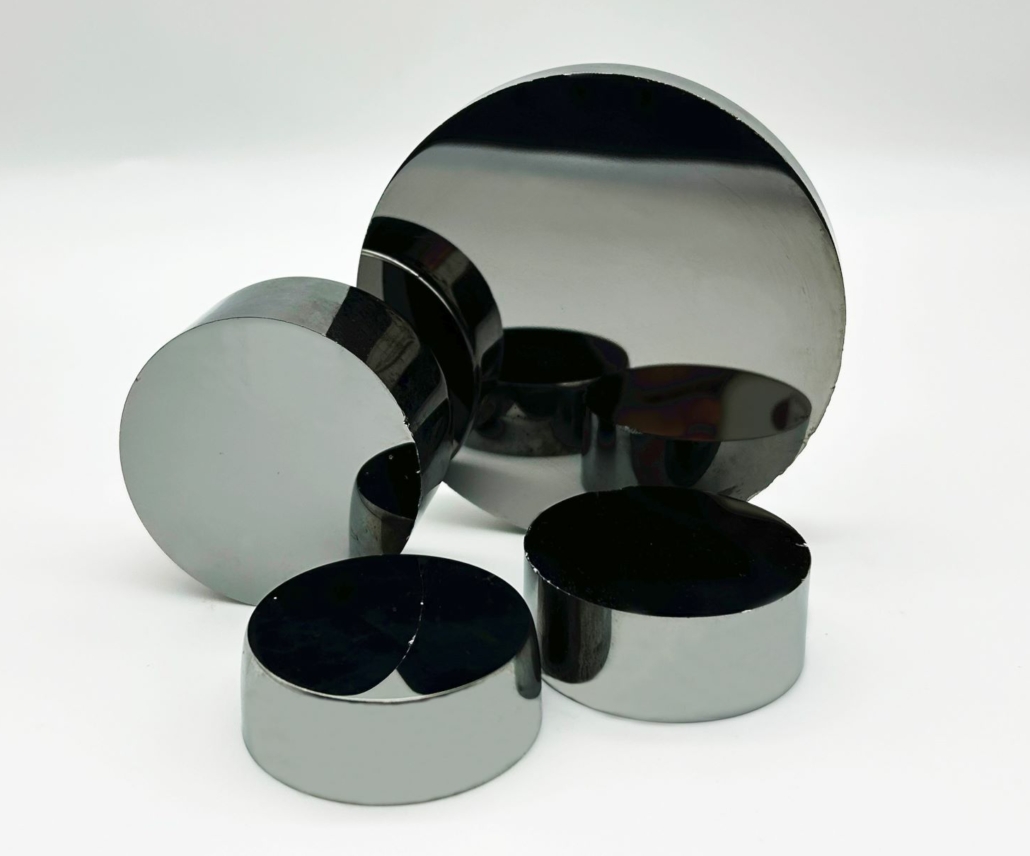
Chalcogenide Glass: a complete guide
Chalcogenide glass may be the material you need for your IR optics. It does transmit up to the thermal IR spectrum and can be molded contrary to other IR materials.
This article is summarizing all important information for this material so you can understand if it fits your needs.
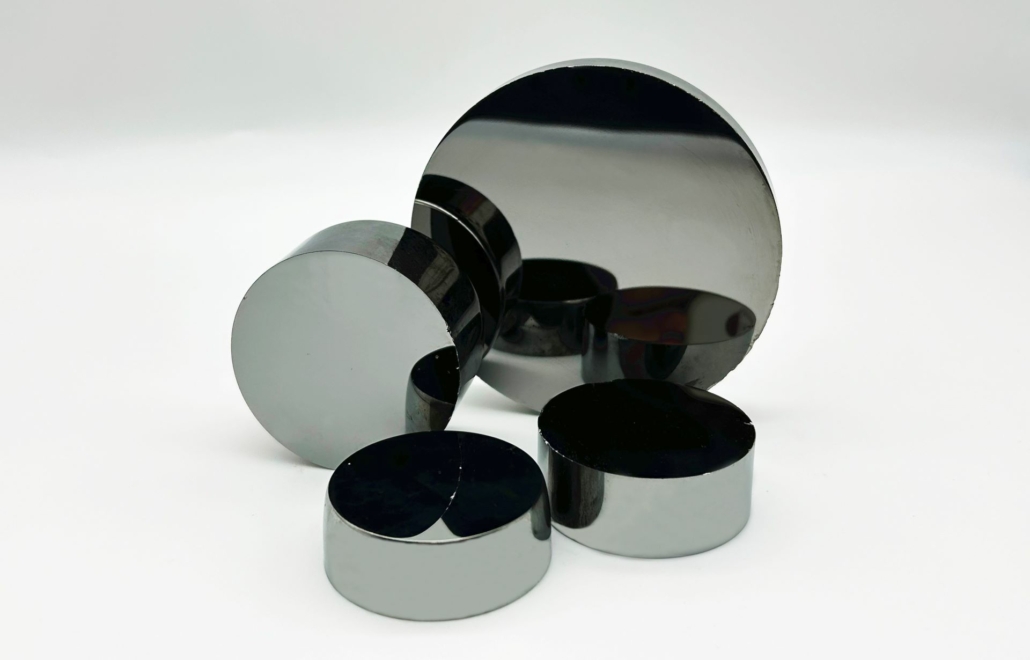
What is Chalcogenide Glass?
Chalcogenide glass is not one type of material, but different materials which consist of chemical elements from group 16 of the periodic table (chalcogenides) in a composition with other elements.
The chalcogenide elements sulfur (S), selenium (Se) or tellurium (Te) are used in an alloy mostly together with arsenic (As), germanium (Ge), antimony (Sb) or gallium (Ga), which stabilize the glass, and can adjust the physical properties.
The typical material codes like IRG22, IRG26 etc. by Schott and IRG201, IRG202 etc. by Chinese manufacturer Hubei New Huaguang (NHG) are used to identify their different types of glasses, where “IRG” stands for “Infrared Glass”. The codes are not to confuse with the chemical formula of the materials, where IRG26 for example is equivalent to the chemical formula Se60As40.
Transmission of Chalcogenide Glass
The broad transmission of chalcogenide glasses reaches from near-infrared and mid-infrared to far-infrared. Depending on its chemical composition, it can transmit wavelengths up to 19um.
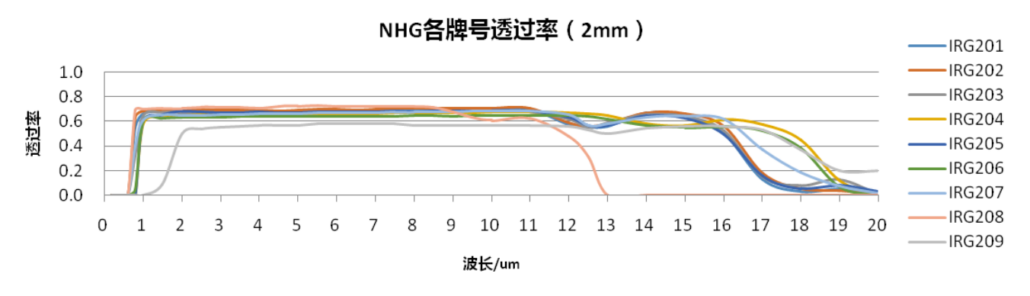
Some compositions can ensure that transmission is not suffering from temperature influence, but is rather stable over a wide temperature range. Furthermore, chalcogenide glasses have a low dispersion as well as high refractive indices.
In conclusion, even compared to other established IR materials like ZnSe, germanium or BaF2, Chalcogenide can offer favorable transmission.
Which other characteristics does it offer?
Compared to other IR materials, Chalcogenide glass is a soft material. That makes it unsuitable for applications which are exposed to harsh environments or physical impact. Furthermore, it also does not allow a high polishing grade, leading to a lower achievable surface quality. It can also challenge the manufacturing process, since manufacturing marks are easy to appear.
Molding of IR Components
The softness as a key disadvantage in comparison to other IR materials, also enables one of it’s biggest advantages: the option to use to mold or press it into the demanded shape.
Injection molding can be specially interesting when high quantities need to be produced in a short time. That especially might be the case for the production of aspherical lenses which have to be manufactures by single-point-diamond turning otherwise. But it might also be the case for spherical lenses which have to be polished individually.
Available Components and Applications
Chalcogenide components can be considered as a comparatively cheap material solution, and can be used to realize a lot of different optical components. Even though, as mentioned above, molding is favorable in some cases, single-point-diamond turning is possible as well.
Chalcogenide glasses are often used for IR Lasers, which require a high transmission to minimize absorption and heat induced damage. In this context IR windows and IR lenses made from chalcogenide glass can be used.
Chalcogenide Lenses can substitute Germanium components in lens assemblies or other applications. This can specially be interesting, since the export of germanium, even though possible, can be delayed because of the mandatory export license (exports from China).
Chalcogenide Glass, a solution for thermal IR Components
Chalcogenide glass has a very good transmission in the 8-12 µm range, and also offers a low thermal expansion, which makes the optical system more stable against temperature changes.
This characteristic makes it appealing for a lot of industrial applications or thermal night vision in the automotive industry.
Available Coatings
As discussed before, chalcogenide is a soft material. But Diamond Like Coating (DLC) can be applied. However, precondition is to coat an intermediate layer of germanium, which classifies it as a material with export restrictions (exports from China). Even though that means that the delivery time of the component will extend, considering the volatile price of Ge raw material, choosing that solution might still bring a financial benefit.
Besides DLC, multiple AR coatings are available for chalcogenide glass.
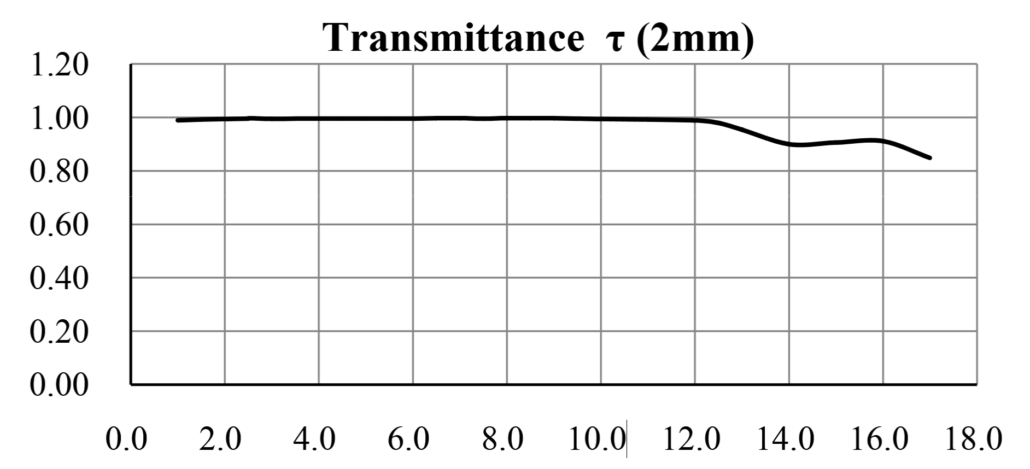
The coated Chalcogenide glass Se60As40 (NHG Material Code IRG206) for example offers a transmission of over 98% @8-12um. That means it outperforms ZnS and can compete with ZnSe regarding the transmission range.
Chalcogenide Glass compared to other IR Materials
A comparison on how chalcogenide glass performs compared to other IR materials can be found in the table below.
| Pros (Compared to Chalcogenide) | Cons (Compared to Chalcogenide) | |
| Germanium | – DLC coating possible | – requires export license – heavy |
| ZnSe | – broad transmission | – can not be molded |
| Sapphire | – harder, more suitable for harsh conditions – UV transmission | – lower transmission in IR – harder to process |
| Silicon | – low cost | – low transmission in IR spectrum (normally requires AR coating) |
| Barium Fluoride (BaF₂) | – UV to LWIR transmission | – expensive |
If you are searching for potential chalcogenide glass solutions for your optics, or are planning to substitute IR materials with chalcogenide glass, don’t hesitate to ask Sinoptix for support.
