
THz materials : a complete guide
THz wavelengths are particularly interesting for various scientific, medical, and industrial applications due to their non-ionizing nature (safer than X-rays which are ionizing radiations) and ability to penetrate various materials.
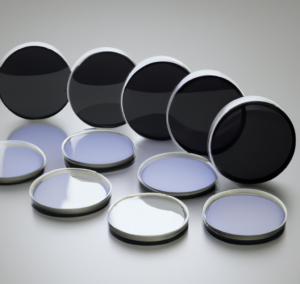
What is THZ ?
Terahertz (THz) radiation refers to electromagnetic waves with frequencies ranging from 0.1 to 10 Thz (10^12 hertz). This spectral range lies between the microwave and infrared areas of the electromagnetic spectrum, corresponding to wavelengths from 3mm to 30µm.
Materials transparent to THz radiation
Different materials exhibit varying degrees of transparency to THz radiation, metals for example are mostly opaque to THz waves. Below is a table listing some of the common materials that are transparent to THz waves and can be used as THz optical components. The table also shows relevant technical information such as refractive index, absorption coefficient, bandgap, visible transparency, and relative pricing.
| Material | Transparent in the visible | Refractive index (@ 1 Thz) | Absorption Coefficient (cm-1) | Bandgap (eV) | Pricing (relative) | Remarks |
|---|---|---|---|---|---|---|
| TPX (polymethyl-pentene) | yes | 1.46 | less than 0.05 | – | Low | Highly transparent in the THz region, very good low temperature performances both optically and mecanicaly |
| Teflon (PTFE) | no | 1.43 | less than 0.05 | – | Low | Excellent THz transparency and low absorption |
| PE (polyethylene) | no | 1.52 | less than 0.1 | – | very low | common low cost window for THz systems |
| COP (Cyclo-olefin polymer) | no | 1.53 | less than 0.1 | – | low | Good optical properties |
| Polycristalline Diamond | yes | 2.38 | less than 0.1 | 5.5 | very high | Exceptional thermal properties and mechanical resistance |
| HR-Si (High resistivity Silicon) | no | 3.42 | 0.1-10 | 1.1 | Moderate | easy to work resistant material |
| Sapphire | yes | 3.1-3.2 | less than 0.2 | 9.9 | High | Excellent thermal and chemical stability |
| ZnSe (Zinc Selenide) | partial | 2.4 | less than 0.2 | 2.7 | Moderate | An alternative to HR-SI for THz lenses and windows |
| GaP (Gallium Phosphide) | Yes | 3.2 | less than 0.5 | 2.26 | High | High refractive index and low absorption. |
| Fused silica | yes | 2.1-2.4 | 0.1-0.5 | 8.9 | Low | Cheap inert material |
To go further on these materials
Below some links introducing more into details the above mentioned materials, please follow them to get more insight.
Material with crystalline structure such as Silicon, Germanium, Sapphire and Fused silica which have a relatively high refraction index and thus a higher reflectance shows lower transmission than organic materials like TPX, Teflon or PTFE.
Crystalline materials are to be preferred for higher power applications (higher than 1 mJ).
Applications of THz optics
Thz optics are used in a wide range of applications :
- Imaging systems: medical imaging, security scanning, and non destructive testing (food, medicine etc.)
- Spectroscopy: identification of chemicals
- Communications: high speed free space systems
As natural THz radiations are rather small, THz systems usually include a source, emitting THz radiations and a camera or sensor that will be used to receive the signal.
Looking for THz windows or THz lenses ?
SINOPTIX provides optical components, namely windows, spherical lenses, cylindrical lenses and hemispherical lenses in all of the above chart materials, don’t hesitate to contact us for a quote or technical information.


