
Optical materials transmission spectrum chart
Choosing the right material from UV to LWIR – THz
Selecting the right optical material is critical for your system performance. Transmission range, refractive index, and environmental durability all vary significantly across materials.
This chart provides a quick comparison of the most commonly used optical materials, showing their transmission windows from UV to long-wave infrared (LWIR) along with their typical refractive indices (nd).
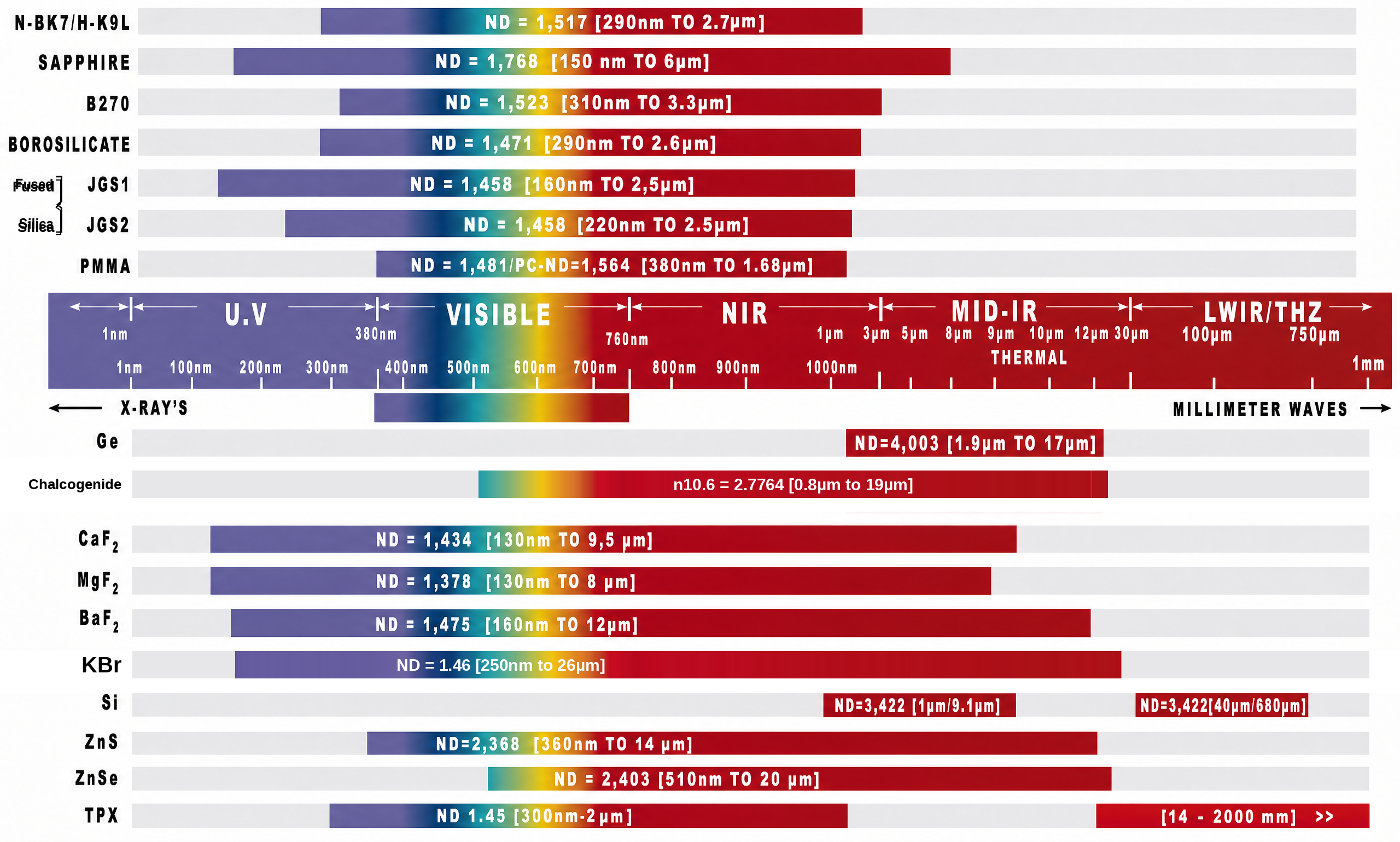
How to read the chart
- The horizontal axis represents the electromagnetic spectrum, from
UV (nanometers) on the left to
LWIR / THz (millimeters) on the right. - Each bar shows the practical transmission range of a material.
- The value “ND” indicates the refractive index at the d-line (587.6 nm)
or a representative wavelength. - Overlapping regions help identify
alternative materials for the same spectral band.
Information provided in this chart are for reference only, transmission is impacted by material thickness, coatings, angle of incidence, surface quality and so on..
Working with frequency instead of wavelengths ? If you need simple way to change wavelengths in frequency go to our optical wavelength / frequency converter.
Key takeaways
- UV applications (< 350 nm):
Fused silica (JGS1), CaF2, MgF2 and sapphire offer the best performance - Visible optics (400–700 nm):
Standard glasses like optical glass, B270, and borosilicate are cost-effective choices - Near-Infrared (NIR):
Materials such as CaF₂ and BaF₂ provide extended transmission with low dispersion - Mid-IR (3–12 µm):
ZnSe, ZnS, and silicon are interesting due to their high transmission - LWIR / Thermal imaging (8–14 µm):
Germanium, chalcogenide glass and ZnSe are widely used despite higher refractive indices - THz
Use of TPX or Si-HR is recommended
Design considerations
Transmission spectrum is only one parameter of an optical design, but to select the best materials other parameters need to be considered too :
- Mechanical strength and hardness
- Thermal resistance
- Cost and manufacturability
- Material availability and export restrictions.
- Refractive index
- Dispersion (color aberration)
Other resources on optics :


